The National Center Russia in Moscow, venue of the "Digital Solutions" forum
MOSCOW (Shahid Ghumman) — Russian Prime Minister Mikhail Mishustin has said the government will determine when only sovereign, Russian-developed foundational artificial intelligence models are to be used in the country’s sensitive sectors and critical infrastructure.
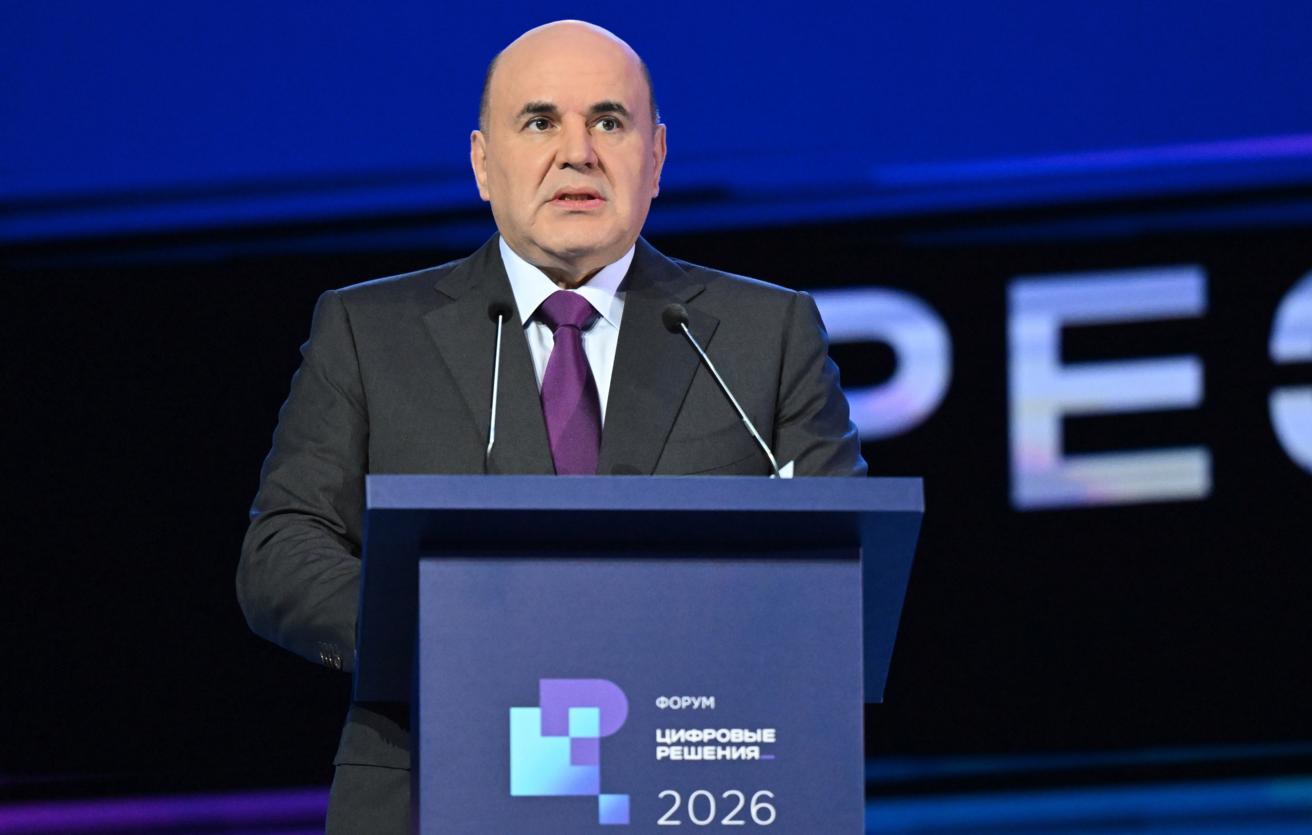
Speaking at the “Digital Solutions” forum held at the National Center Russia in Moscow, the prime minister also directed the Ministry of Digital Development, Communications and Mass Media to further strengthen the protection of citizens’ accounts on the state services portal “Gosuslugi”.
Mishustin noted that 120 million people now use the Gosuslugi portal, making the protection of users’ personal data critically important. He instructed the ministry to develop additional security requirements for accessing the platform and restoring accounts.
According to the prime minister, the number of cybercrimes fell by nearly a third in the first eight months of 2026 following amendments to legislation.
He also called for expanding the bug-bounty program that rewards independent experts for finding vulnerabilities in state websites. He said rewards of up to one million rubles are paid for identifying a security flaw in the Gosuslugi portal, while thousands of independent experts take part in the program testing the security of state information systems.
Mishustin said that on President Putin’s instructions, the Russian government is preparing a strategy for developing sovereign systems and digital platforms. The goal, he said, is to ensure that the failure of a single cloud service or software product cannot cause large-scale disruption to industrial production and essential public services.
He said the total turnover of digital companies in the country has exceeded 21 trillion rubles after growing by nearly 20 percent in a year, adding that the digital sector has become an important part of the Russian national economy.
Sales of Russian software products reached nearly three trillion rubles in the first half of 2026 — about a third more than in the same period last year, he said.
Around 20,000 IT companies have confirmed their accreditation and received government incentives, according to Mishustin. He said that for every ruble the state spends on the sector, about two and a half rubles return to the national budget.
The prime minister said the government will support IT projects for heavy and basic industries and the development of Russian AI-based solutions, with the state budget able to cover a large share of the costs of such important projects.
He said Russian companies should move swiftly toward domestic technology. Under normal conditions, companies will be free to choose technology according to their needs, but in critical infrastructure and sensitive sectors the government will decide when only Russia’s sovereign AI models are used.
Mishustin warned that countries seeking global dominance in artificial intelligence want to make other nations dependent on their technology. Russia cannot allow such a situation for itself, he said, which is why developing domestic technology is a matter of national competitiveness and digital sovereignty.
He also stressed the need for cooperation between the government and business to define clear limits on the powers and responsibilities of AI-driven agents, so that digital systems work predictably and without disruption.
The prime minister said revenues of Russian online cinemas, music streaming services and e-books have doubled over the past two years. He added that he himself uses VK services and Yandex’s AI assistant “Alice”.
On e-commerce, Mishustin said Russia ranks first in the world among the 20 largest e-commerce markets in terms of growth rate, holding the position for the fifth consecutive year.
He said online sales in Russia exceeded 13 trillion rubles by the end of 2025 — more than a fifth of the country’s total retail trade — with digital platforms accounting for about 70 percent of all online sales.
On communications, the prime minister said the communications services market grew 13 percent in 2025 to reach 2.5 trillion rubles. The number of base stations rose by nearly nine percent over the year to one million, while the 4G network now reaches almost all households in Russia.
Mishustin said accelerating the transition to domestically produced telecom equipment is essential for the successful development of 5G in Russia. Russian companies have already produced more than 10,000 domestic base stations, he said.
He said that alongside activating 5G networks in Moscow, St. Petersburg, Yekaterinburg and dozens of other cities, the foundation for the next generation of communications must be laid now.
The prime minister added that 8,000 small settlements were provided with LTE mobile internet over the past six years, and more than 1,500 additional small settlements will receive it this year.
Mishustin said Russian digital platforms, including VK, are providing world-class services to citizens despite unprecedented restrictions. He expressed confidence that, given Russia’s geographically and communications-significant position, even unfriendly countries will eventually have to recognize the need to cooperate with Moscow.
Report date: October 6, 2026
About The Author