By Muhammad Shehryar Shahid
When relations between two countries are discussed, the conversation usually begins with diplomacy, trade, energy and official visits. Agreements are signed, delegations travel, ministers meet and new areas of cooperation are announced.
But some of the strongest relationships between nations are built much more quietly.
They begin in university classrooms, research laboratories, student residences, cultural festivals and language centres. They grow when a young Pakistani begins speaking Russian with classmates, or when a Russian student starts to understand Pakistan beyond headlines and geopolitics.
That quieter relationship between Pakistan and Russia is becoming increasingly important.
More than a thousand Pakistani students are currently studying at Russian universities and educational institutions. The number may still be modest when compared with Pakistan’s huge youth population and Russia’s vast higher education system, but behind every student is a personal story and, potentially, a future connection between the two countries.
For Pakistan and Russia, education may eventually prove to be one of the most durable forms of cooperation.
A journey from Skardu to Moscow
When Akhtar Hussain left Skardu, a mountainous city in northern Pakistan, for Moscow, the distance he travelled could not be measured only in kilometres.
He was moving from one language to another, from one educational culture to another and from the mountains of Gilgit-Baltistan to one of the largest cities in Europe.
Today, Akhtar is studying Foreign Languages and Intercultural Communication at HSE University in Moscow.
For him, Russia has become more than the country where he came to earn a degree.
It has become a place where history he once encountered through books became something he could see, where he participated in university events, played football, volunteered and met students from different parts of the world.
Speaking about his decision to study in Moscow, Akhtar has described coming to Russia as a major step in his life. Growing up in Skardu, surrounded by mountains and a very different cultural environment, he wanted to experience another education system and meet people from other countries.
His experience reflects a much larger story quietly developing between Pakistan and Russia.
Diplomatic relations are usually measured through official visits, agreements, trade figures and political meetings.
But relationships between societies are built differently.
They are built in classrooms.
They grow in university corridors, student residences, cultural festivals and language centres. They deepen when a Pakistani student begins speaking Russian with classmates, or when a Russian student hears Urdu not in a textbook but from a friend sitting beside them.
Behind the figure of more than a thousand Pakistani students in Russia are individual journeys like Akhtar’s.
And those journeys may eventually become one of the strongest human foundations of Pakistan-Russia relations.
From Islamabad to Moscow
Muhammad Abdullah Tariq arrived in Moscow with a different academic background and a different ambition.
A graduate of Government and Public Policy from Pakistan’s National Defence University, he chose HSE University for a master’s programme in Science, Technology and Innovation Management and Policy.
For Abdullah, the attraction was not simply the idea of studying abroad.
He wanted international exposure and an opportunity to understand how governments and societies prepare for technological change.
His academic interests brought him into an environment where students from different countries debate science, innovation, technology and public policy from different perspectives.
He has also spoken about one of the challenges faced by international students in Russia: language.
Russian can be difficult for newcomers.
Yet that difficulty is also part of the experience.
For Pakistani students, learning Russian means gradually becoming less dependent on translation and more connected to the society around them.
They can speak directly with professors.
They can understand announcements.
They can communicate with neighbours, travel more independently and participate more fully in university life.
Language turns a foreign country into a place that becomes understandable.
And that transformation matters far beyond education.
When language becomes culture
The cultural relationship between Pakistan and Russia is often described in broad terms.
But it becomes much easier to understand when seen through small events.
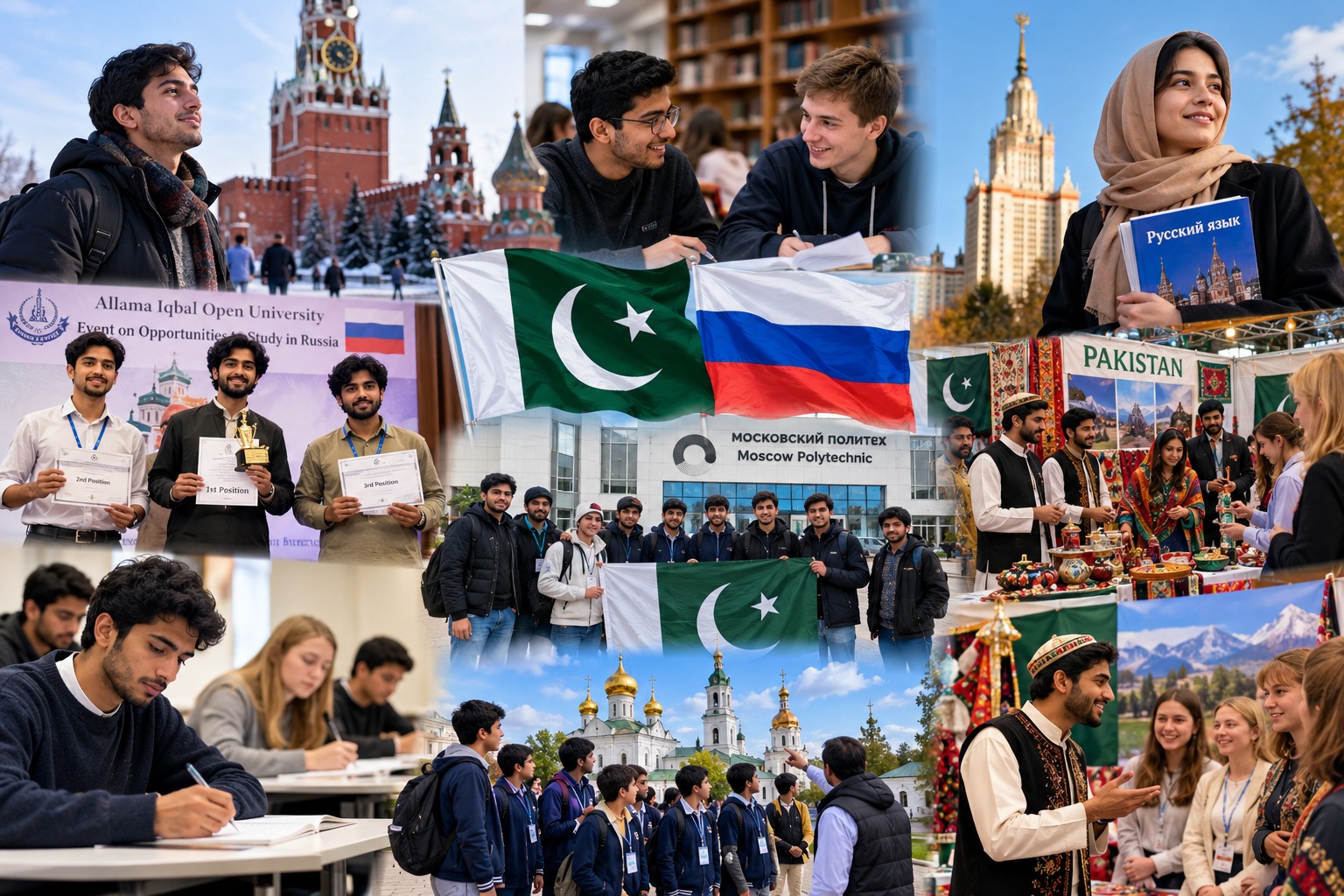
In June 2025, students gathered at Allama Iqbal Open University in Islamabad for an event on opportunities to study in Russia.
Alongside presentations about Russian universities, admissions and scholarships, there was something far less formal: a Russian tongue-twister competition.
Rahat Ali finished first.
Saad Ahmed Khan came second.
Shehryar Khan took third place.
Three Pakistani students competing over Russian pronunciation may seem like a small event.
Culturally, however, it says something important.
Language learning is no longer confined to diplomatic institutions or specialist departments.
Young Pakistanis are beginning to engage directly with Russian language and culture.
The university’s Russian Language Center has been training Pakistani students with support from Russian educational partners.
For some students, Russian may eventually become the language in which they study engineering or medicine.
For others, it may lead to careers in research, translation, diplomacy, journalism or business.
And for some, it may simply become the first doorway into understanding a country they previously knew only from a distance.
Twelve students, one beginning
Another scene unfolded thousands of kilometres away in Moscow.
In July 2026, twelve Pakistani students completed a preparatory programme for foreign students at Moscow Polytechnic University.
Before beginning their undergraduate and postgraduate programmes, they had studied Russian alongside other academic subjects.
A preparatory course rarely makes international headlines.
But for a foreign student, it represents an important transition.
Students arrive unable to understand much of what is happening around them.
Months later, they can follow lectures, communicate with classmates and navigate everyday life.
That change is not only linguistic.
It is personal.
Students gradually move from observing Russian society to participating in it.
Friendships form.
Classmates become guides to a new culture.
Foreign streets become familiar.
A city that initially seemed intimidating begins to feel like home.
The Pakistani students completing that course did not simply pass an academic stage.
They crossed a cultural threshold.
Pakistani culture inside a Russian university
Cultural exchange also works in the opposite direction.
At the National University of Science and Technology MISIS in Moscow, Pakistani students took part in the university’s Nationalities Day festival in May 2026.
Their stall displayed Pakistani traditional clothing, jewellery and handicrafts.
Folk music and dance brought another side of Pakistan into a Russian university setting.
For Russian students walking through the festival, Pakistan was no longer an abstract country thousands of kilometres away.
It had colours.
It had music.
It had clothes, crafts and people standing in front of them explaining their traditions.
This is one of the simplest and most effective forms of cultural diplomacy.
No formal speech can completely replace direct human contact.
A student who has never visited Pakistan may still remember the first Pakistani song they heard at a university festival.
A Pakistani student who has never previously celebrated a Russian cultural tradition may later take that memory home.
Culture moves through such encounters.
Ten Pakistani teenagers in Ivanovo
Not every educational exchange requires a university degree.
In July 2026, ten students from Islamabad Model College for Boys travelled to Ivanovo for a two-week educational programme at the International School Interdom.
They studied Russian language, participated in cultural activities and were given the opportunity to experience Russian life directly.
Their programme also included visits beyond the classroom, including exposure to Moscow and the historic cities of Russia’s Golden Ring.
These students were younger than many Pakistanis who travel to Russia for university education.
That may make their experience even more significant.
For a teenager, a first international educational visit can permanently change the way another country is understood.
Russia stops being a place seen on television or maps.
It becomes the language spoken by a teacher.
It becomes a meal shared with classmates.
It becomes streets, museums, conversations and personal memories.
When these students return to Pakistan, they carry those experiences with them.
In that sense, they become informal cultural ambassadors without holding any official title.
A bridge must work in both directions
Education cannot become a genuine bridge if movement takes place only from Pakistan to Russia.
More Russian students also need opportunities to encounter Pakistan.
Russian universities already have students and researchers interested in Pakistan, South Asia and the Urdu language.
At the Moscow State Institute of International Relations, Russian students study Pakistan and the region, including Urdu.
That matters.
A Russian student who learns Urdu is doing more than learning grammar.
They gain access to Pakistani literature, media, history and everyday conversation.
They can understand Pakistan through Pakistani voices rather than only through translation.
In the future, such students may become diplomats, researchers, journalists, academics or business professionals working with South Asia.
Pakistan needs Russian-speaking specialists.
Russia also needs people who genuinely understand Pakistan.
A durable relationship requires both.
The practical side cannot be ignored
Behind the positive stories, however, there are practical difficulties.
Educational cooperation only works when a student can actually reach the classroom.
Admission to a Russian university is only the beginning.
Students must also complete documentation, receive an official study invitation, obtain a visa and arrive before academic deadlines.
A delay at any stage can affect an entire academic year.
In recent months, delays in the issuance of visa invitations for Pakistani students have emerged as a serious concern. There have also been reports in Moscow of several students who received university admission but faced difficulties in beginning their studies because their visa invitations were not issued in time.
This does not diminish the broader progress in Pakistan-Russia educational relations.
But it does show where practical work is still required.
If both countries want more Pakistani students to study in Russia, admissions, invitations, visas and university coordination need to become more predictable.
A student who has received university admission should know what happens next.
Students and families should also have a clear understanding of the process before paying fees, arranging travel or making major financial commitments.
Greater clarity would benefit universities as well.
It would also reduce the space available to fraudulent education and visa agents who sometimes exploit uncertainty and sell false promises to families.
Students have responsibilities too
The responsibility does not rest entirely with institutions.
International students must also respect the purpose for which they enter another country.
A study visa is meant for education.
Students are expected to attend classes, comply with migration rules and respect the laws and culture of their host country.
Their conduct matters not only to themselves.
Every international student leaves an impression.
When a Pakistani student performs well academically, respects university rules and interacts positively with Russian society, the reputation created can help students who come later.
In that sense, young Pakistanis studying abroad represent more than themselves.
They become part of how their country is understood.
Cultural exchange requires responsibility on both sides.
The host country provides opportunity.
The student must treat that opportunity seriously.
More than soft diplomacy
Education and cultural exchange are often described as soft diplomacy.
The phrase can make them sound less important than trade, energy or infrastructure.
In reality, they can produce very concrete results.
Akhtar Hussain may return from Moscow with academic qualifications, Russian-language ability and professional relationships extending across countries.
Muhammad Abdullah Tariq is studying science and technology policy in an international environment at a time when innovation is becoming central to national development.
The twelve Pakistani students at Moscow Polytechnic are learning not only their future professions but also how to function in Russian society.
The teenagers who travelled to Ivanovo will return to Pakistan with memories of a country they have now experienced personally.
These are real outcomes.
A freight train connects markets.
A pipeline connects energy systems.
Students connect societies.
And relationships between societies often last much longer than individual projects.
What Pakistanis discover in Russia
For many Pakistanis, Russia is initially imagined through a handful of familiar images.
Moscow.
Snow.
The Kremlin.
Russian history.
International politics.
Living in the country creates a much more complex picture.
Students encounter ordinary Russian life.
They ride the metro every morning.
They shop in local supermarkets.
They study alongside Russian classmates.
They experience winter not as an image but as something that changes daily routines.
They discover museums, literature, music and traditions.
And Russians meeting Pakistanis also encounter something beyond familiar international headlines.
They learn about Pakistani cities.
They taste Pakistani food.
They hear Urdu and regional languages.
They see traditional clothing and discover cultural similarities that may not have been obvious before.
This matters because relations between countries are easier to strengthen when societies are not strangers to each other.
Government relations can improve rapidly.
Public understanding develops much more slowly.
Education can shorten that distance.
From one thousand to a generation
The current number of Pakistani students studying in Russia remains modest compared with what is possible.
Pakistan has one of the world’s largest young populations.
Russia has a vast university system with strengths in medicine, engineering, science, technology and many other disciplines.
There is considerable room for educational ties to grow.
But expansion should focus on quality rather than numbers alone.
Students should have access to reliable information.
Universities should be properly recognised.
Admissions should be transparent.
Visa procedures should be predictable.
Scholarship opportunities should be publicised widely.
Degree recognition should be clearly explained.
And students should receive support after arrival.
If those elements come together, the number can grow naturally.
More importantly, the quality of the experience will improve.
A student who returns home with a good education and a positive understanding of another country may influence bilateral relations for decades.
The relationship people remember
Governments change.
Economic conditions change.
International politics changes.
But personal memory often lasts.
A Pakistani student who spends years in Moscow may remember the Russian professor who helped when a course became difficult.
A Russian student may remember the Pakistani classmate who introduced them to Urdu or Pakistani food.
A teenager returning from Ivanovo may speak about Russia to friends and family in a way no official information campaign ever could.
These are small stories.
Together, they become a relationship between societies.
Pakistan and Russia are expanding cooperation in trade, energy, agriculture, transport, science and technology.
All of those fields are important.
But alongside them is another form of infrastructure being built.
Human infrastructure.
It is made of language, education, friendships, professional relationships and shared experiences.
Akhtar Hussain’s journey from the mountains of Skardu to a Moscow university is part of that infrastructure.
So is Muhammad Abdullah Tariq’s pursuit of science and technology policy.
So are twelve students learning Russian before beginning their degrees.
So are ten teenagers discovering Russia in Ivanovo.
And so are Pakistani students presenting their music and traditions to Russian classmates at a Moscow university festival.
None of these stories alone defines Pakistan-Russia relations.
Together, however, they show something that diplomatic statistics cannot.
Two societies are beginning to know each other through people.
And perhaps the strongest bridge between Pakistan and Russia will not be the one that appears on a map.
It will be the one carried home by the young people who crossed it.
About The Author