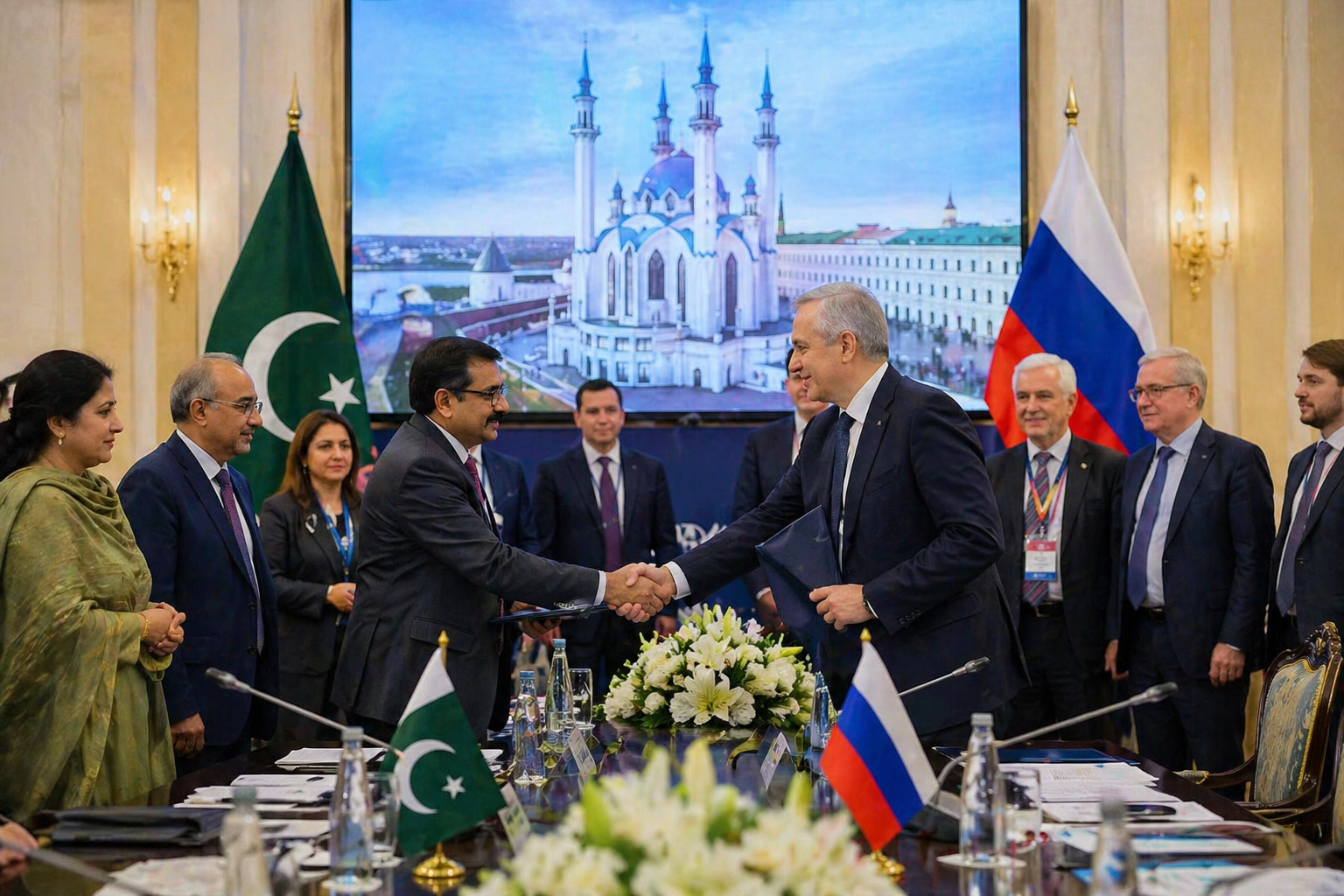
KARACHI/ISLAMABAD (Voice Of Russia): Academic cooperation between Pakistan and Russia is set to further strengthen as the second Russia–Pakistan International Conference will be held in Kazan, Russia, from May 12 to 17, 2026.
Titled “The Evolution of Russia–Pakistan Relations in a Changing Global Order,” the conference will be organized under the internationally recognized Russia–Islamic World Kazan Forum 2026, bringing together experts, researchers, and policymakers from around the world.
The event is being jointly organized by Kazan Federal University and the Federal Urdu University of Arts, Science and Technology (FUUAST), Islamabad, with collaboration from the National University of Sciences and Technology (NUST) and the Consortium for Asia Pacific & Eurasian Studies (CAPES).
The conference is being held under the patronage of Prof. Dr. Zabta Khan Shinwari (Vice Chancellor, FUUAST) and Prof. Dr. Lenar Rinatovich Safin (Rector, Kazan Federal University). It is also supported by the Ambassador of Russia to Pakistan, Albert Khorev, and the Ambassador of Pakistan to Russia, Faisal Niaz Tirmizi, reflecting the growing strength of bilateral relations.
This conference builds on the success of the first Russia–Pakistan conference held in Karachi in February 2025, which was considered a significant milestone in enhancing academic ties between the two countries.
A high-level academic delegation from Pakistan is expected to participate, including Prof. Dr. Zabta Khan Shinwari, Prof. Dr. Khalid Mehmood Iraqi (Vice Chancellor, University of Karachi), Prof. Dr. Ghazala Yasmeen (Vice Chancellor, Women University Swabi), and Prof. Dr. Sajid Mehmood Shehzad (Vice Chancellor, Minhaj University), along with other senior academics, researchers, and representatives from the business community.
The conference will cover key topics such as geopolitics, regional connectivity, economic cooperation, security, and cultural exchange.
Experts believe that the conference will not only strengthen academic diplomacy between Pakistan and Russia but will also promote research collaboration and enhance people-to-people contacts.
About The Author