Shahid Ghumman, Maktoob-e-Moscow
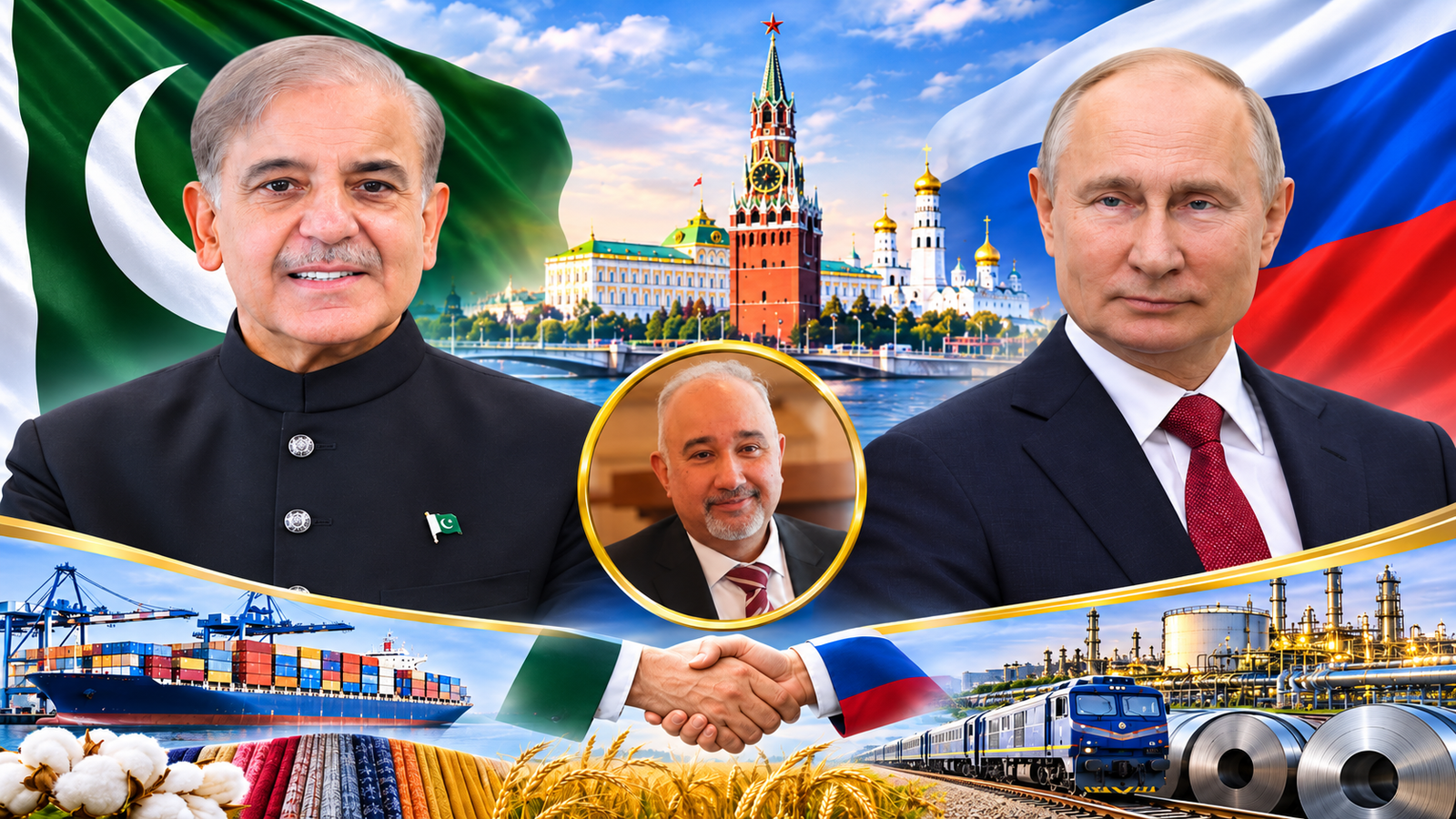
Pakistan-Russia relations are now entering a stage where warm political contacts need to be translated into real economic, trade and people-to-people benefits. Prime Minister Mian Muhammad Shehbaz Sharif is expected to visit Russia in the first week of December, and if the programme proceeds in the planned direction, this visit could prove to be an important milestone in relations between the two countries.
Prime Minister Shehbaz Sharif and President Putin have met several times over the past few years. Political contact exists between the two leaderships, there is positive thinking about each other, and both Pakistan and Russia have already expressed that relations should not remain confined to diplomatic statements alone.
Now the need is for the next step.
During the Prime Minister’s expected visit, a meeting with President Putin is also expected. The importance of this meeting will not be limited to formal diplomacy. The real question will be how much practical progress the two leaderships can make on the issues of trade, energy, investment, banking, visa facilitation, transport and business links that have for years slowed the pace of economic partnership between the two countries.
Trade has not yet reached the level to which political relations between Pakistan and Russia have improved.
According to Pakistan’s official figures, bilateral trade in fiscal year 2025 was stated at 243.412 million dollars. Considering the population, economies, resources and geographical importance of the two countries, this volume is very small.
Russia is among the world’s major economies. It has vast capacity in energy, oil, gas, wheat, fertiliser, machinery, mining, nuclear technology, railways, industrial production and science.
On the other hand, Pakistan is a large market of more than 240 million people. We have several sectors, including textiles, rice, fruit, vegetables, seafood, sports goods, surgical instruments, leather products, medicines and information technology, which can find a place in the Russian market.
The real problem is not a lack of opportunities.
The real problem is reaching those opportunities.
If a Pakistani trader wants to come to Russia and faces difficulties in obtaining a visa, if a Russian company wants to do business in Pakistan but there is no clear route for payment and banking, if there is no direct flight between the two countries, if delivering goods takes more time and cost, then good political relations alone cannot automatically increase trade.
These are the issues that should be raised on a priority basis during the Prime Minister’s visit.
The most important issue is that of visa facilitation.
Business takes place between people. If traders cannot easily reach one another, how will business links grow?
The Pakistani business community has long felt the need to simplify the procedure for Russian business visas and invitations. As far as students are concerned, problems of delay in the issuance of visa invitations have also come to light.
If political relations between Russia and Pakistan are truly reaching a new level, the effect of this change should also be visible in visa policy.
For businesspeople, students, experts, journalists and official delegations, there should be a procedure in which legal and security requirements remain in place, but unnecessary delays and complications are reduced.
Alongside this, the second and perhaps the biggest problem is that of banking and payments.
After the Western sanctions against Russia, major changes have taken place in the international financial system. Several countries have created alternative financial arrangements to continue trade with Russia.
Pakistan will now also have to find a permanent solution to this problem.
For a businessman, the most basic question is: after selling the goods, how will the payment be received?
If the answer to this basic question is not clear, trade does not move forward.
The central banks, commercial banks and relevant ministries of both countries can create a formal system under which lawful business payments can be made securely. Work can be done on various options, including local currencies, a third acceptable financial system or a specific banking channel.
Pakistani business circles have also described letters of credit, banking channels and payment problems as obstacles to access to the Russian market.
If this problem is resolved, an increase in trade will no longer remain merely a wish; it will become a practical possibility.
One major and perhaps the most interesting aspect of the Prime Minister’s visit will be the Pakistan-Russia Business Forum.
Pakistan’s Ambassador Faisal Niaz Tirmizi has already announced that more than 100 prominent Pakistani companies will come to Russia for this forum and will make direct contact with their Russian counterparts.
This number is important in itself.
But the real success will not be the number of companies; it will be the outcome of these meetings.
Alongside the business forum, advance contacts between companies and preparations for B2B meetings are also under way, so that after reaching Moscow, Pakistani companies do not merely hold introductory conversations but already have possible partners, sectors and projects identified.
This method is more effective.
A business forum succeeds when, after the meeting, a Pakistani company finds a buyer in Russia, a Russian company finds a partner in Pakistan, a joint venture begins, or a real shipment of goods is dispatched as a result of an agreement.
For Pakistani companies, there is considerable potential in Russia in textiles, rice, fruit, vegetables, seafood, surgical instruments, sports goods, medicines and information technology.
For Russian companies, there are opportunities in Pakistan in energy, gas, oil, steel, machinery, transport, railways, mining, agricultural technology and industrial projects.
These are the sectors where political closeness can be turned into business partnership.
Work is also under way on several agreements and memoranda of understanding during the Prime Minister’s expected visit. Earlier, Pakistan’s Ambassador Faisal Niaz Tirmizi had said that the two countries are working on eight to ten agreements, including a roadmap for economic cooperation until 2030.
If this roadmap does not remain merely a document and annual targets are also set alongside it, its importance can increase greatly.
For example, where should trade reach in the next three years?
How much Russian investment should be brought to Pakistan?
How many Pakistani products should enter the Russian market?
When should direct air links begin?
When should freight railways run on a permanent basis?
When should the banking system be activated?
If the answers to these questions are settled with dates and responsible institutions, that will be the real economic roadmap.
In this entire process, the role of Pakistan’s Ambassador Faisal Niaz Tirmizi is also prominent.
His diplomatic activities in Moscow have not remained limited to the formal circles of the Russian Foreign Ministry or the Kremlin.
He is continuously increasing contacts with different regions of Russia, economic forums, universities, business institutions and regional governments.
Whether it is a meeting with Governor Vladimir Solodov in Kamchatka, contact with the investment institutions of Tatarstan, forums in Kazan, a visit to the Alabuga Special Economic Zone, regional cooperation with Krasnodar, or meetings with MGIMO and other universities and business institutions in Moscow, a clear effort is visible to ensure that Pakistan-Russia relations are not confined merely to the official offices of Moscow and Islamabad.
Russia is a very large country.
Moscow is certainly important, but Russia is not only Moscow.
Tatarstan has its own industrial strength, the Far East has its own resources, Kamchatka has its own scientific and natural potential, and there are various opportunities in agriculture and trade in Russia’s southern regions.
Therefore, Pakistani diplomacy reaching different regions of Russia is the right direction.
Faisal Niaz Tirmizi has repeatedly pointed to three basic matters: visa facilitation, direct air links and better logistics.
These are, in fact, the keys to the next stage of Pakistan-Russia relations.
The Ambassador has also increased contacts with the Pakistani business community. In meetings with the chambers of Islamabad and Rawalpindi, the opportunities of the Russian market, B2B contacts, joint ventures, payment, visa and banking issues were discussed.
This work is important because the benefit of diplomacy reaches the common man only when it creates ease in business, employment, education and trade.
The energy sector can also hold a central position in the Prime Minister’s visit.
Pakistan has long faced the problem of the price and availability of energy, while Russia is among the world’s major energy-producing countries.
Cooperation with Russia in oil, LNG, gas, hydropower and energy infrastructure can be important for Pakistan.
But here too, mere purchasing is not enough.
Pakistan will have to focus on Russian investment, joint ventures and the transfer of technology.
There has also been talk of Russian cooperation regarding Pakistan Steel Mills. Historically, Pakistan Steel Mills has been a symbol of relations between the two countries. If industrial cooperation moves forward again under a new workable model, it will be an important symbolic and practical development in the economic relations of the two countries.
Transport and connectivity are no less important.
There are no direct flights between Pakistan and Russia.
A businessman often has to travel via a third country to go from Moscow to Pakistan or from Pakistan to Russia.
Direct air connectivity is necessary not only for tourism but also for trade, education and investment.
Similarly, the concept of a freight railway from Pakistan to Russia via Iran, Turkmenistan and Kazakhstan can be extremely important for both countries.
If Pakistan’s ports and railway network come into permanent contact with Russia and Central Asia, Pakistan will not only reach the Russian market but can become part of the vast Eurasian trading system.
Pakistan’s geographical position is our greatest strength here.
The ports of Gwadar and Karachi can provide a possible route to the Indian Ocean for Russia and Central Asia.
This is the point where Pakistan-Russia relations can move beyond bilateral trade and become part of regional connectivity.
Education should also be an important part of the agenda of this visit.
Russian universities hold a strong position in science, engineering, medicine and technology. More than a thousand Pakistani students are already studying in Russia.
But for Pakistani students, there are delays in visa invitations, documentation and certain administrative problems.
If the two countries create a clear and reliable system for students and increase scholarships, education can become a powerful means of bringing the peoples of the two countries closer.
Ambassador Faisal Niaz Tirmizi has also expressed the desire to increase the number of Pakistani students significantly in the future.
But before increasing the number, it is necessary to make the path easier.
Despite all this progress, one reality should not be ignored.
Political will exists in Pakistan-Russia relations.
Now the test is of implementation.
President Putin has already described Pakistan as a close partner of Russia and has spoken of increasing cooperation in trade, diplomacy, education, agriculture, pharmaceuticals, railways, industry, health and information technology.
Pakistan’s leadership also wishes to further expand relations with Russia.
The expected visit in December will be an opportunity to give practical shape to this political will.
If, after the expected meeting between Prime Minister Shehbaz Sharif and President Putin, visas become easier, a banking channel is created, progress is made towards direct flights, business deals emerge from B2B meetings, Russian investment comes to Pakistan and Pakistani products find more space in the Russian market, then this visit will truly prove to be the beginning of a new stage.
In my view, the measure of this visit’s success should not be the joint statement or the number of signatures.
The real success will be that, a few months later, a Pakistani trader faces fewer difficulties in coming to Russia.
A Russian investor is able to start a project in Pakistan.
A Pakistani student receives a visa invitation on time.
Pakistani products are seen in the Russian market.
And lawful and secure transfer of money between the two countries becomes possible.
Pakistan and Russia have spent several decades understanding each other.
Now is not the time merely to count possibilities.
Now is the time to turn these possibilities into trade, investment, education and people-to-people contacts.
If Prime Minister Shehbaz Sharif’s expected visit to Moscow in December and his expected meeting with President Putin keep these very practical issues at the centre, this visit will not remain just another official visit in the history of Pakistan-Russia relations.
It can become a step taking the two countries from political closeness towards a real economic partnership.
About The Author