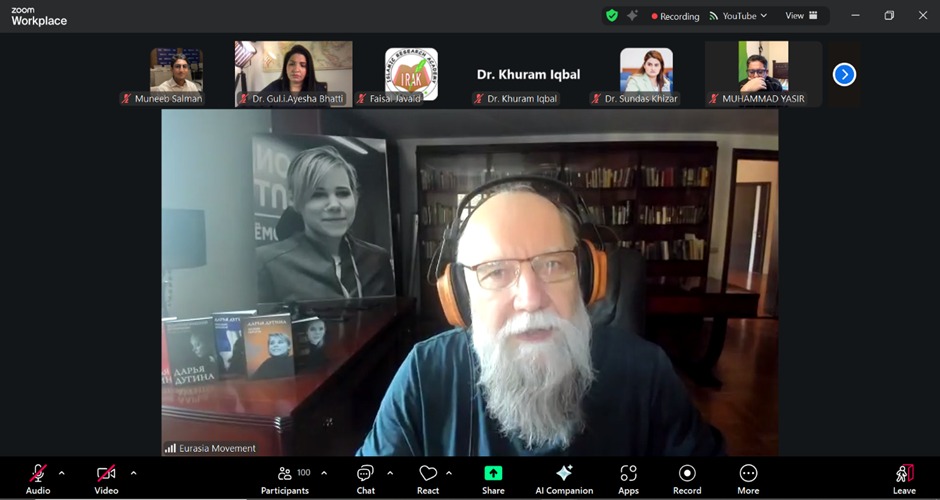
Moscow(Voice Of Russia): The Consortium for Asia Pacific and Eurasian Studies (CAPES), in collaboration with the Tsargrad Institute, organized an online lecture by renowned Russian philosopher Aleksandr Dugin on “Eurasianism and Pakistan’s Strategic Location” under its Distinguished Lecture Series.
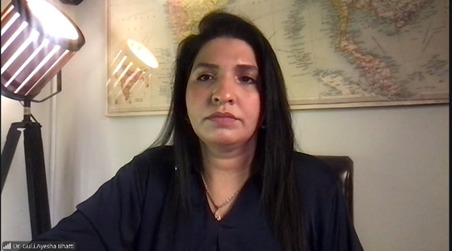
The session was attended by academics, practitioners, media professionals, and students, and was moderated by Dr Gul-i-Ayesha Bhatti.
In his address, Dugin stated that the global order established after the 1990s is now undergoing a major transformation, with the decline of unipolarity and the rise of a multipolar world order.
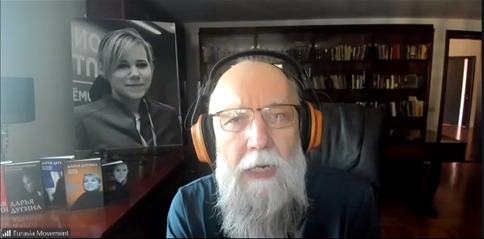
He emphasized that “civilizational states” are emerging across different regions, where societies are redefining their own values, political systems, and identities. He noted that the decline of liberal globalism and the rise of civilizational and religious perspectives are reshaping the international system.
Dugin further argued that this transition is being resisted by the US-led unipolar system, leading to tensions and conflicts in various parts of the world.
Highlighting Pakistan’s role, he described it as a key actor within the Islamic civilization due to its strategic location, alliances, and nuclear capability. He added that Pakistan has adopted a cautious approach amid ongoing global shifts but may need to define its position more clearly.
In his concluding remarks, CAPES President Dr Khuram Iqbal noted that Pakistan is pursuing a foreign policy based on national interests in a rapidly changing global environment. He stated that the concept of Eurasianism is reflected in Pakistan’s shift toward geoeconomics in its 2022 National Security Policy.
He also pointed out that Pakistan faces challenges such as terrorism, tensions with Afghanistan, and opposition from India, which hinder regional cooperation in Eurasia and the Asia-Pacific region.
About The Author