Shahid Ghumman, Maktoob-e-Moscow
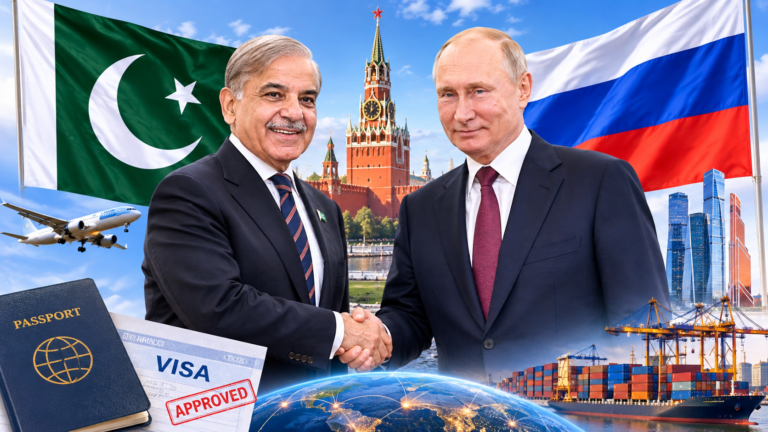
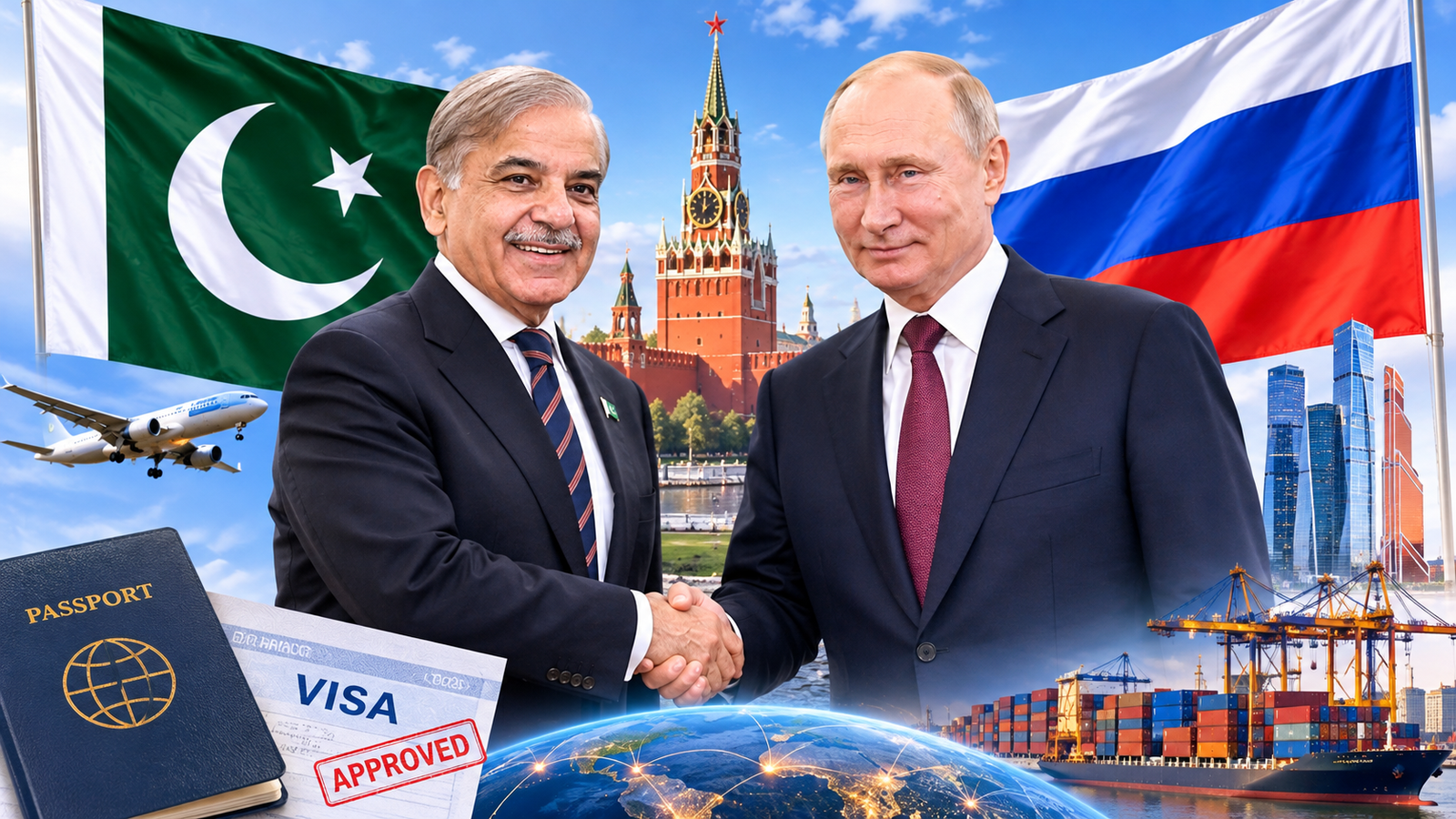
Prime Minister of Pakistan Mian Muhammad Shehbaz Sharif is coming to Moscow on a three-day official visit to Russia from 30 November to 2 December. The visit comes at a time when political trust between Pakistan and Russia is growing, new targets have been set for economic cooperation, and a formal programme has already been put forward to expand trade, investment, energy, education and regional connectivity between the two countries.
The Prime Minister’s meeting with Russian President Putin, his address to the Pakistan-Russia Business Forum, direct meetings between businesspeople of the two countries and an expected session with Pakistani students are the important features of the visit.
What sets this visit apart from past diplomatic engagements, however, is that this time the Prime Minister is coming to Moscow against the backdrop of an economic programme on which the two countries signed formally just a few days ago.
At the 11th session of the Pakistan-Russia Intergovernmental Commission in Moscow, the programme of economic cooperation for 2026-2030 and the protocol of the commission were signed. At the session, co-chaired by Federal Minister for Energy Awais Ahmed Khan Leghari and Russian Minister of Energy Sergei Tsivilev, the two countries also set a target of taking bilateral trade to five billion dollars by 2030.
The economic programme covers several sectors, including trade, investment, energy, industry, agriculture, pharmaceuticals, transport, information technology, education, science and culture.
On 27 November, Federal Minister for Energy Awais Leghari also briefed Prime Minister Shehbaz Sharif on the outcomes of the Intergovernmental Commission held in Moscow. In this sense, considerable preparation at the economic and technical level has already been completed before the Prime Minister’s visit. Now the whole process needs political support and practical decisions at the leadership level.
The importance of the meeting with President Putin
The Prime Minister’s meeting with President Putin will be the central and most important diplomatic part of the visit.
The two leaders have met before on the sidelines of international forums, but a meeting during a formal bilateral visit is different in nature. It is not only about exchanging views on a few global or regional issues; it is an opportunity for detailed discussion on the overall direction of bilateral relations, economic priorities and future partnership.
The meeting between President Putin and Prime Minister Shehbaz Sharif is expected to cover important matters, including energy, trade, investment, industrial cooperation, defence ties, regional security, the situation in Afghanistan and economic connectivity with Central Asia.
Russian cooperation on Pakistan Steel Mills, joint projects in the oil and gas sector, railway links, direct flights and the banking system are also important subjects on this wider economic agenda.
There are also reports that around 15 to 16 agreements and memoranda of understanding may be signed during the visit. However, their final number and nature will be determined by the formal announcements made during the visit.
In my view, the greatest importance of this meeting is that it offers an opportunity to place directly before the top leadership of both countries those problems which are difficult to resolve at the lower administrative and technical levels.
In particular, the problems of visa invitations and banking are such that without resolving them, achieving the trade target of five billion dollars will remain a major challenge.
Five billion dollars of trade, but how much is current trade?
Pakistan and Russia have set a target of five billion dollars in bilateral trade by 2030. To understand the significance of this target, it is also necessary to look at the current volume of trade.
According to figures stated by Federal Minister for Energy Awais Ahmed Khan Leghari in July 2026, trade between Pakistan and Russia exceeded one billion dollars in fiscal year 2024, but fell to around 243 million dollars in fiscal year 2025.
This fluctuation in trade indicates that while trade opportunities exist between the two countries, much work remains to be done to put economic relations on a permanent footing.
If the five-billion-dollar target is to be achieved, Pakistan and Russia will have to move beyond traditional trade methods. Both countries will have to provide an environment in which businesspeople can easily reach each other’s markets, invest, conclude agreements and make payments through legal banking channels.
These are the fundamental problems that should be given priority during the Prime Minister’s visit.
The visa problem, the biggest concern of the Pakistani business community
For the Pakistani business community in Moscow, the most worrying issue at present is the problem of visa invitations.
For the past several months, Pakistani businesspeople have faced severe difficulties in obtaining invitations for Russian business visas. The situation is such that for many Pakistani traders, obtaining new business invitations has become almost impossible.
Pakistani students face the same problem. Despite securing admission to Russian universities and paying their tuition fees, many Pakistani students are waiting for visa invitations.
On the other hand, the position of the Russian Foreign Ministry is that there is no general ban on issuing visas to Pakistani students.
On 20 November, during the weekly press briefing of Russian Foreign Ministry spokesperson Maria Zakharova, I raised the matter of visa invitations for Pakistani students. She once again made it clear that there is no ban on visas for Pakistani students and that, if the specific cases of affected students are provided, they will be examined individually with the relevant Russian institutions.
This assurance from the Russian Foreign Ministry is important in itself, but the situation on the ground remains a cause of concern for Pakistani students and businesspeople.
Information issued by some Russian universities also mentions a temporary suspension of the issuance of study invitations for Pakistani citizens.
If there is no official ban, then why has the normal process of invitations not been restored? What is the real reason for this administrative obstacle, and what steps can the relevant institutions of both countries take to remove it?
These are questions whose answers must now be found at the highest diplomatic level.
Raising the case of each affected student or businessperson individually may be a temporary solution, but it is not a permanent one. What is needed is an institutional arrangement under which applications from Pakistani citizens who fulfil all legal requirements are processed in the normal way.
If a Pakistani businessman cannot come to Russia to conclude an agreement with a Russian company, exhibit his products or attend a trade forum, then how will bilateral trade grow?
This is an important opportunity for Prime Minister Shehbaz Sharif to raise this issue directly in his meeting with President Putin and to agree on clear instructions to the relevant ministries of both countries for its permanent resolution.
Why no Russian e-visa for Pakistan?
Ambassador of Pakistan Faisal Niaz Tirmizi, in a recent interview with Dunya News, expressed the desire to establish a mutual visa-free system between Pakistan and Russia. He also mentioned that Pakistan is issuing electronic visas to Russian tourists.
Pakistan has provided an online visa facility for Russian citizens. However, a complete visa-free system for ordinary Russian passport holders has not yet been implemented.
The visa facility provided by Pakistan can serve as a basis for Russia to also show appropriate flexibility in its visa system for Pakistani citizens.
Russia has made notable progress in recent years on visa facilitation with several countries.
The agreement on mutual visa-free travel for ordinary passport holders between Saudi Arabia and Russia came into force on 11 May 2026. A visa-free facility exists for organised tourist groups with Iran, while talks are also under way with India on a visa-free system for group tourism.
Russia has also introduced a unified electronic visa system for citizens of 64 countries, including India, Iran, China, Saudi Arabia and Turkiye.
But Pakistan is not on this list.
The important feature of the Russian electronic visa is that it does not require a traditional invitation. Citizens of eligible countries can apply online and come to Russia for tourism, short business visits and certain other approved purposes.
The proposal to include Pakistan in this list could become part of the agenda of the Prime Minister’s visit.
It is not necessary for Pakistan and Russia to move immediately towards a complete visa-free system. In the initial phase, providing the electronic visa facility to Pakistani citizens would also be a major step forward.
Along with this, agreement can also be reached on long-term business visas, multiple-entry facility and a clear procedure for issuing study invitations.
However, the regular student visa system for students will remain in place, and its existing obstacles will have to be removed separately.
The warmth expressed in diplomatic relations between Pakistan and Russia should also be visible in the travel of ordinary citizens of both countries.
Talk of promoting people-to-people contacts, tourism, trade and education will be more effective when people of both countries genuinely find it easier to travel to each other’s countries.
Pakistan-Russia Business Forum, from meetings to agreements
During the Prime Minister’s visit, the Pakistan-Russia Business Forum is also expected to be held in Moscow on 2 December, in which business enterprises, investors, industrialists and companies from various sectors of both countries will take part.
Prime Minister Shehbaz Sharif will address the forum, while direct business meetings will also be held between Pakistani and Russian companies.
In preparation for the forum, Ambassador of Pakistan Faisal Niaz Tirmizi has already mentioned the participation of more than one hundred Pakistani companies. However, the final number of companies taking part in the forum will become clear at the time of its holding.
The gathering of such a large number of business enterprises in one place is an important development, but the results of the Business Forum should not be measured only by the number of participants.
These meetings should turn into business agreements under which new buyers are found for Pakistani products in the Russian market, Russian investors start their projects in Pakistan, and companies of both countries move towards joint production and investment.
For this, it is necessary that a formal system exists to maintain contact between companies even after the Business Forum.
At most international business forums, companies meet each other, contacts are established and memoranda of understanding are also signed, but later the results of these meetings do not materialise because of administrative, financial and travel obstacles.
The Pakistan-Russia Business Forum should be different from this traditional pattern.
Three or six months after the forum, it should be reviewed how many business meetings turned into real trade, how many new orders were obtained, how much progress was made on investment projects and which obstacles still need to be removed. This is the approach that can bring the five-billion-dollar trade target closer to reality.
The banking and payment system, the basic need of trade
After visas, the second major practical problem in Pakistan-Russia relations is that of financial transactions.
After Western sanctions on Russia, major changes have taken place in the international banking and payment system. Several of Russia’s trading partners have established alternative financial arrangements according to their needs.
Talks are also under way between Pakistan and Russia in this regard, but the business community now needs a clear and reliable system.
Before the Prime Minister’s visit, officials of both countries held special talks in Moscow on the bilateral payment system. The participation of the Governor of the State Bank of Pakistan in the recent Intergovernmental Commission also shows the importance of this matter.
For business enterprises, payment is not merely a technical issue but the foundation of the entire business.
If a Pakistani exporter sells goods to a Russian buyer, he should be confident that his money will reach Pakistan on time and through legal means. Similarly, a Russian company should also have financial security in its dealings with Pakistan.
Work can be done on the possibilities of establishing a legal financial system for payment in local currencies, Pakistani rupees and Russian roubles, through specific banking channels or mutual settlement.
This arrangement should be accessible not only to large companies but also to small and medium-sized enterprises.
The problem of Pakistanis living in Russia sending money to Pakistan is also linked to the same financial obstacle.
I had also pointed out this problem in my previous column: due to the lack of easy and accessible formal banking channels, Pakistanis living in Russia face difficulties in sending their legitimate earnings home.
This problem is not only of traders but also of Pakistani families, professionals and students living in Russia.
If a legal financial system is established between the two countries, it should also provide a safe and transparent facility for remittances of ordinary citizens along with business payments.
After setting a trade target of five billion dollars, the question has become even more important: under which financial system will payments for such large trade be made?
The Prime Minister’s visit should bring clear progress towards answering this question.
Expected progress in energy, industry and investment
Energy and industrial cooperation are also expected to remain central in the meeting between President Putin and Prime Minister Shehbaz Sharif.
Talks are already under way at various levels between Pakistan and Russia on oil, gas, LNG, electricity and energy infrastructure.
For Pakistan, the importance of cooperation in the Russian energy sector is not limited to the purchase of oil and gas. Joint projects, investment, local production, technical expertise and the development of energy infrastructure can provide more lasting benefits.
The ongoing cooperation between the two countries on Pakistan Steel Mills also deserves special attention.
Pakistan Steel Mills has been an important symbol of the historic industrial relations between the two countries. Its revival or the preparation of a new project on modern industrial foundations could be important for industrial development, local production and employment opportunities in Pakistan.
However, the success of large industrial projects requires financial arrangements, a workable investment model, transfer of technology and a clear timeline.
The Prime Minister’s visit provides an opportunity to build high-level consensus on these matters.
Direct flights and freight railway
Another fundamental obstacle in Pakistan-Russia relations is the absence of direct air connectivity.
Businesspeople, students, tourists and Pakistani families travelling between the two countries generally travel via a third country. This increases both the duration and the cost of travel. Ambassador Faisal Niaz Tirmizi has also been consistently pointing out this problem.
If progress is made on direct air connectivity during the Prime Minister’s visit, its benefit will not be limited to the aviation sector alone; it can have a positive impact on many sectors, including trade, tourism, education, investment and people-to-people contacts.
Similarly, the proposed freight railway link from Pakistan to Russia via Iran, Turkmenistan and Kazakhstan is also an important part of economic cooperation.
Talks and agreements have already taken place at various levels in this regard. Transport and railway cooperation was also focused on in the recent Intergovernmental Commission.
Now there is a need to set a clear timeline for the start of the proposed projects and their permanent commercial use.
Direct flights and permanent land trade routes can prevent the geographical distance between Pakistan and Russia from turning into economic distance.
The Prime Minister’s meeting with Pakistani students
The expected session of Prime Minister Shehbaz Sharif with Pakistani students in Moscow is also an important and human aspect of the visit.
More than one thousand Pakistani students are studying in various universities and educational institutions in Russia. These young people can play an important role in future educational, scientific, cultural and business links between Pakistan and Russia. But at present, the same problem of visa invitations stands before educational cooperation.
There are students and families in Pakistan who completed all the necessary steps for admission to Russian universities, paid the fees and prepared their documents, but their education could not begin while they wait for invitations. Some students face uncertainty about their educational future. Some Pakistani students already studying in Russia have also complained of difficulties regarding the extension of their visas.
These problems should receive special attention in the Prime Minister’s meeting with students. Along with contacts between the Pakistani Embassy and Russian universities, there should also be an arrangement at the level of the relevant Russian ministries so that the legitimate matters of students can be resolved in a timely manner.
New agreements on educational cooperation, increase in scholarships and targets to increase the number of Pakistani students are important in their place, but it is equally necessary to provide an opportunity to students who have already secured admission to begin their education.
Education is a sector through which relations between the two countries are carried to future generations.
A Pakistani young person studying in Russia today can tomorrow become a means of contact with Russian companies, universities, research institutions and business circles in Pakistan.
Therefore, resolving the visa problems of Pakistani students is not merely an educational necessity but also a long-term investment in Pakistan-Russia relations.
Diplomatic preparation and the role of Ambassador Faisal Niaz Tirmizi
The role of Pakistan’s Ambassador Faisal Niaz Tirmizi is also noteworthy in the economic talks, the holding of the Intergovernmental Commission, the preparation of business delegations and continuous contacts with Russian institutions before the Prime Minister’s visit.
Over the past several months, along with increasing business and educational links, he has consistently stressed the need for visa facilitation, direct air connectivity and the removal of financial and trade obstacles.
The signing of the economic cooperation programme up to 2030 and the preparation of the Business Forum before the Prime Minister’s arrival in Moscow are part of this wider diplomatic effort.
Now these efforts need decisions at the leadership level and effective coordination between the relevant institutions.
President Putin’s possible visit to Pakistan
Another important diplomatic aspect of Prime Minister Shehbaz Sharif’s visit to Moscow is the possible invitation to President Putin to visit Pakistan.
Reports have appeared in the Pakistani media that during his meeting, the Prime Minister may invite the Russian President to visit Pakistan next year, particularly in the context of the expected SCO summit in Islamabad in 2027.
If President Putin visits Pakistan in the future, it will be a notable diplomatic development in relations between the two countries.
However, before that, the Prime Minister’s current visit needs to produce results that make future high-level contacts between the two countries even more purposeful.
Pakistan-Russia relations should also be seen in a wider global context.
Better relations with Russia are not a substitute for Pakistan’s relations with any other country, but an important addition to Pakistan’s balanced, national-interest-based foreign policy.
Pakistan needs to build relations with different global and regional powers that benefit the national economy, investment, trade, energy and national development.
The real test after the three-day visit
Prime Minister Shehbaz Sharif’s visit to Russia, starting on 30 November, will last three days, but its results and effects could be important for many years to come.
The meeting with President Putin, the Pakistan-Russia Business Forum, business negotiations between companies, the session with Pakistani students and the expected signing of various agreements make this visit a comprehensive diplomatic and economic programme.
But in my view, the real success of this visit will be judged less by the declaration issued at the end of the visit and more by the changes that take place in the coming months.
If Pakistani businesspeople start receiving Russian business visa invitations in the normal way, the obstacles to Pakistani students’ study invitations are removed, progress is made towards including Pakistan in the Russian electronic visa system, a legal banking and remittance system is established, clear decisions come forward for direct flights and freight railway projects, and the Business Forum’s agreements turn into real trade, then the benefits of this visit will also be felt by ordinary Pakistanis.
Pakistan and Russia have set a trade target of five billion dollars by 2030. Now a path must also be built to reach this target.
A businessman must be provided travel facilitation, a student a timely visa, an investor confidence, an exporter payment security, and a Pakistani living in Russia a safe means of sending his legitimate earnings home.
The political foundation of Pakistan-Russia relations is already becoming stronger. The economic cooperation programme has also been agreed. Now there is a need to turn this political trust into a practical partnership whose benefits reach the people of both countries beyond official meetings and agreements.
Prime Minister Shehbaz Sharif’s visit to Moscow and his meeting with President Putin can lay the foundation for this change.
In Pakistan-Russia relations, implementation now matters more than possibilities. The journey towards five billion dollars of trade will also begin on the day when the practical obstacles between the people, business enterprises and investors of both countries start being removed.
About The Author